
According to a 2024 Coface payment study, 78 percent of German companies report late payments from their customers - a figure that has been rising steadily since 2021. At the same time, the data shows: Receivables that are overdue for more than 180 days are never paid in around 80% of cases worldwide.
For medium-sized businesses, this is not an abstract statistic. It is a real threat to liquidity, growth - and, in extreme cases, to the very existence of the company.
The good news: structured accounts receivable management can be built up step by step. With the right roadmap, SMEs can noticeably improve their cash flow in 60 days - without immediately relying on external financing.
This guide shows you how.
Why revenue alone is not enough without liquidity management
Many companies grow - and still run into financial bottlenecks. The reason: A profitable business can go bankrupt if outstanding payments do not cover its current liabilities.
The core problem lies in accounts receivable accounting: invoices are issued, payments fail to arrive - and the dunning and collection process starts too late or not at all. The larger the volume of outstanding receivables, the tighter the liquidity.
Rule of thumb: Revenue is what you deliver. Liquidity is what keeps you alive.
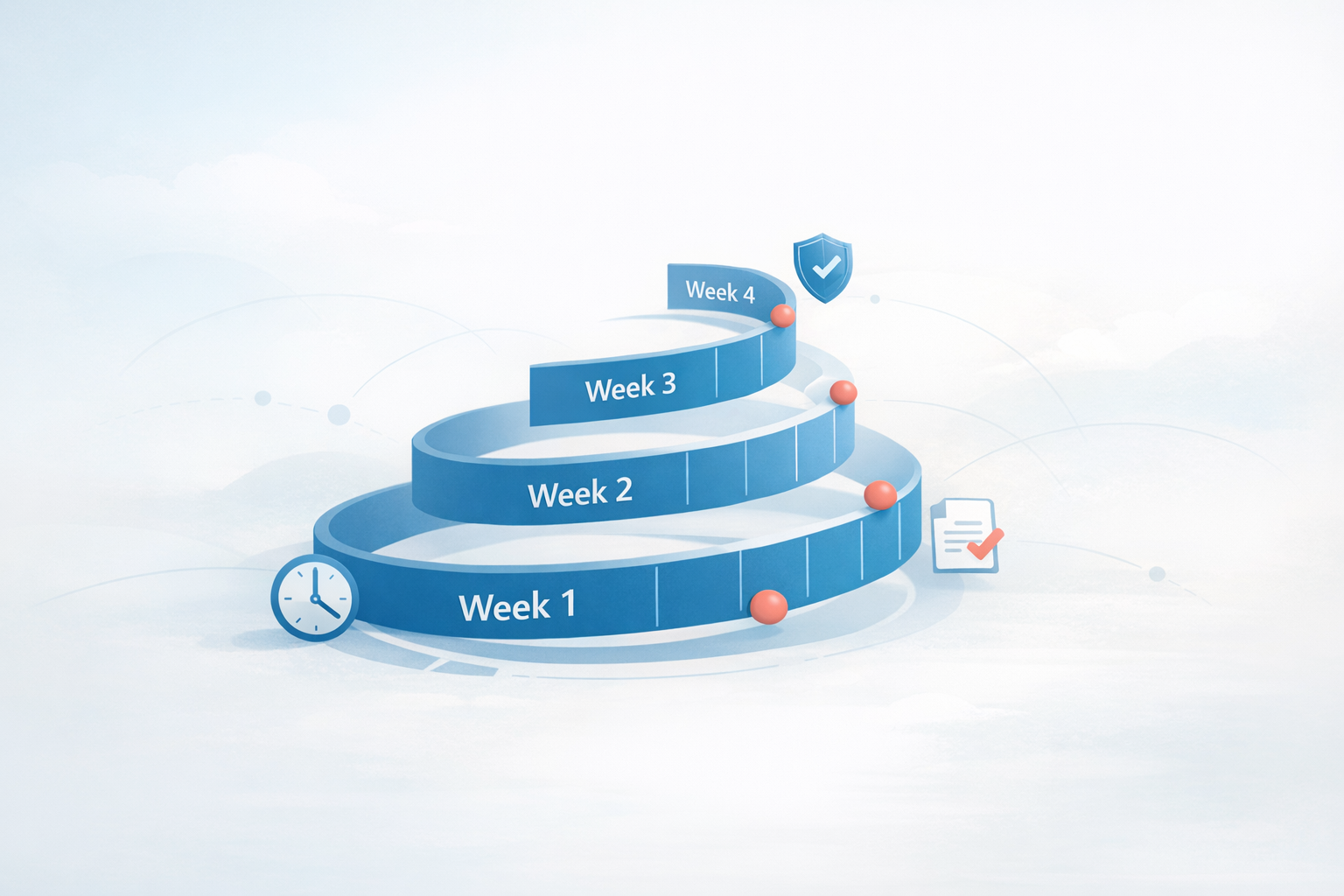
The 60-day roadmap: Week-by-week to better cash flow
Weeks 1-2: Assessment & transparency (Days 1-14)
Goal: Full clarity on your current receivables situation.
Before you optimize processes, you need a candid picture of where you stand. This assessment forms the foundation for all further measures.
Tasks in this phase:
- Update the open items list: sort all outstanding receivables by due date
- Calculate DSO (Days Sales Outstanding): (average receivables ÷ annual revenue) × 365
- Identify the top 10 debtors by volume and risk
- Document existing payment terms and dunning/collection processes
- Obtain a credit check on your largest debtors (business credit report)
✅ Success criterion: You know your DSO, your highest-risk customers, and the status of every outstanding item.
Benchmark: The average payment term in German B2B business is around 32 days. If your DSO is significantly higher, immediate action is needed.
Weeks 3-4: Optimize dunning and internal processes (Days 15-30)
Goal: Introduce consistent dunning procedures and ensure invoice quality.
A structured dunning and collection process is the fastest lever for improving cash flow - and is, in practice, one of the most neglected.
Tasks in this phase:
- Define standardized dunning levels:
- Payment reminder: Day +3 after due date
- 1st dunning notice: Day +14
- 2nd dunning notice with grace period: Day +21
- Collection escalation: Day +30
- Review invoice templates: all mandatory information included, correct purchase order references, digital dispatch
- Set payment terms by customer segment (e.g., new customers: 14 days, regular customers: 30 days)
- Consider early payment discounts for suitable customers
- Define and document thresholds for delivery stops and escalation rules
✅ Success criterion: All new invoices follow a standardized process. The first dunning notice is triggered automatically and on time.
Note: Unclear or incomplete invoice details are among the most common reasons for payment delays - more often than deliberate non-payment by customers.
Weeks 5-6: Review and initiate external protection (Days 31-45)
Goal: Transfer risks and strengthen liquidity using external instruments.
Internal processes alone will not protect you from insolvencies or sudden payment defaults. This is where external instruments come into play.
The three most important instruments at a glance:
| Instrument | Protection against | Liquidity effect |
|---|---|---|
| Trade credit insurance | Bad debt losses due to insolvency/non-payment | Indirect (claims compensation) |
| Factoring | Late payment & default | Immediate (80-90% of the receivable) |
| Surety bond (guarantee insurance) | Strain on bank facilities from guarantees | Indirect (relieves credit lines) |
Tasks in this phase:
- Review existing trade credit insurance cover: where are the gaps?
- Assess suitability for factoring: receivables volume, debtor structure, industry
- If needed: obtain independent advice from a specialist broker
- Review guarantee limits: principal bank credit line vs. guarantee insurance
- Compare terms from at least 2-3 providers
✅ Success criterion: You have a sound basis for deciding on at least one external risk protection or financing instrument.
Tip: Independent specialist brokers such as renz credit & consulting compare offers from insurers, banks, and factoring companies on a neutral basis - without being tied to a single provider.
Weeks 7-8: Implementation & cash flow tracking (Days 46-60)
Goal: Put measures into operation, measure impact, and embed routines.
Tasks in this phase:
- Implement or finalize the selected instruments (trade credit insurance, factoring, etc.)
- Recalculate DSO and compare it with the initial value
- Categorize open items by age (aging buckets: 0-30 / 31-60 / >60 days)
- Introduce monthly reporting: receivables ratio, DSO, overdue amounts
- Document results and formally embed processes within the company
✅ Success criterion: DSO has measurably decreased, default risk is clearly covered, and monthly reporting is in place.
Checklist: What belongs in professional accounts receivable management?
- Current open items list is updated weekly
- DSO is calculated and monitored monthly
- Written dunning process with defined levels and deadlines
- Invoice quality is reviewed regularly (completeness, mandatory details)
- Credit checks are performed before supplying new customers on account
- Payment terms are differentiated by customer segment
- Trade credit insurance or factoring is in place for the main receivables portfolio
- Guarantee limits with the principal bank are reviewed regularly and relieved where necessary
- Monthly reporting on receivables position and cash flow is established
When are internal measures no longer enough?
Optimizing internal processes creates a solid foundation. However, certain situations require external support:
- Growth: Rising sales increase the receivables portfolio - and the default risk - proportionally.
- New markets: International business or new industries bring unfamiliar credit risks.
- Concentration risk: A single key customer accounts for 20% or more of your revenue.
- Tight credit lines: Guarantees and sureties fully occupy your bank credit facilities.
- Payment default has occurred: Quick, professional support is critical once a loss event happens.
In these situations, a combination of trade credit insurance, factoring, and strategic financial communications is often the most effective solution. Used intelligently, these instruments not only reduce risk - they actively create liquidity headroom for investment and growth.
Related guide: In the article Effectively unlocking liquidity: 7 concrete measures that work immediately you will find additional quick wins for securing liquidity.
Frequently asked questions about accounts receivable management
What is the difference between accounts receivable management and receivables management?
The terms are often used interchangeably. Accounts receivable management focuses on the ongoing management of customer relationships and payment behavior. Receivables management is a narrower term for the process of actively collecting outstanding amounts - that is, dunning and debt collection.
How fast does factoring have an effect?
With true (non-recourse) factoring, you typically receive 80-90% of the invoice amount within 24-48 hours after selling the receivable. The impact on liquidity is therefore almost immediate.
Who benefits from trade credit insurance?
Trade credit insurance is particularly useful for companies that regularly sell on open account, have several customers with significant individual exposures, or operate in economically sensitive industries. As a rule of thumb: from an annual B2B turnover of around €1 million, it is worth considering.
Can I outsource dunning and accounts receivable management?
Yes. Through factoring solutions, the factor can take over the entire receivables management including dunning. This relieves the accounting department and frees up resources for core business activities.
How do I find the right provider for trade credit insurance or factoring?
The market is complex. Independent specialist brokers compare offers from various providers on a neutral basis and develop a tailored solution - without being tied to a single insurer or factoring company.